The End of IT Projects as We Know Them
Why Enterprise IT No Longer Scales by Adding More People

For most of its history, enterprise IT has operated on a simple assumption. Progress moves at the speed of people.
When organizations needed to modernize core systems, migrate platforms, or untangle decades of accumulated software decisions, they hired more humans. Larger teams. Longer timelines. Carefully assembled résumés. The work was serious, the stakes were high, and the delivery model, while imperfect, was familiar.
For a long time, this worked.
Now it does not.
This is not because engineers have become less capable. If anything, enterprise engineers today are more skilled than ever. The problem is structural.
Systems have grown denser. Timelines have hardened. Deep expertise has thinned. And the margin for error, particularly in platforms like SAP, has quietly vanished.
Enterprises are now being asked to modernize their most critical systems under conditions that would have seemed unreasonable a decade ago. Fixed deadlines. Shrinking pools of specialists. Rising costs. Software estates that encode decisions no one remembers making.
SAP is the clearest example. Some of the world’s most important businesses still run on systems written fifteen or twenty years ago, customized by engineers who have long since moved on. Documentation is incomplete. Business logic lives inside code paths that are rarely touched unless something breaks. And yet these systems are expected to migrate, modernize, and perform on schedule.
It is not surprising that many of these projects run long. Or that quality varies. Or that teams cut corners under pressure and hope the consequences surface later rather than sooner.
What is surprising is how long we have accepted this as inevitable.
Why Enterprise IT No Longer Scales Linearly
Assumption of Traditional IT Projects
Reality in Modern Enterprise Systems
A Question That Has Been Waiting
Sookti began with a question that sounds almost impolite in traditional IT circles.
What if delivery was not constrained by human bandwidth at all?
Not in the sense of replacing people. That discussion is loud, tired, and largely unproductive. The more practical question is this. What if the parts of enterprise delivery that should be consistent, tireless, and repeatable actually were?
For years, automation in IT services meant scripts, accelerators, or tools that helped humans work a little faster. Useful, but incremental.
What has changed is not that machines can write code. It is that they can understand systems.
Recent advances in AI have made it possible to build agents that reason over large, messy codebases. They can infer business logic from implementation details. They can recognize patterns that experienced engineers recognize, but do so across millions of lines of code, without fatigue, and without forgetting what they learned yesterday.
This distinction matters.
From Human Led Services to AI Native Delivery
AI agents can now replicate best in class engineering work at machine scale.
At Sookti, we are building exactly such systems of specialized AI agents that execute work in parallel, continuously, and without the throughput limits imposed by human coordination.
Here's the magic: instead of projects delivered by rotating teams of people, work is delivered by orchestrated systems of agents that can:
- Read and understand large legacy codebases
- Reconstruct missing documentation and business logic
- Identify customizations over standard platforms
- Detect risky or non optimal implementations
- Transform and modernize code
- Test changes against historical and live system behavior
None of this is remarkable in isolation.
But what is new is that these agents do not operate sequentially. They work concurrently, with shared context, as part of a single execution system.
This is the core shift Sookti is built on.
In practical terms, work that once required months of coordination can now happen at machine speed, without sacrificing traceability or control.
Why SAP Was the Obvious Place to Start
If you wanted to test whether this approach actually works, SAP would be an unforgiving proving ground.
SAP systems are old, mission critical, deeply customized, and resistant to shortcuts. Many of the engineers who designed them are gone. Business logic is often implicit. The cost of mistakes is measured in operational disruption, not bug reports.
ECC to S/4HANA migrations do not wait for ideal conditions.
That's why, at Sookti, we have built a growing family of specialized SAP agents that operate across the delivery lifecycle, including agents that can:
- Analyze and document legacy SAP code
- Derive business and technical logic from raw implementations
- Identify customizations relative to standard SAP behavior
- Flag performance, quality, and compliance risks
- Refactor and remediate custom code
- Execute regression and transformation testing
Each agent is useful on its own. Orchestrated together, they become something else entirely.
Our First End to End Product
By coordinating these agents, we have built our first complete product.
A fully autonomous ECC to S/4HANA migration system.
This system brings documentation, analysis, transformation, remediation, and testing into a single continuous workflow, capable of executing large portions of an SAP migration without manual intervention.
Autonomous does not mean unsupervised. Humans still set direction, review outcomes, and make judgment calls. But execution, especially the slow and brittle parts, no longer depends on who happens to be available in a given quarter.
The Architecture Behind Sookti
Sookti is built as a layered AI system.
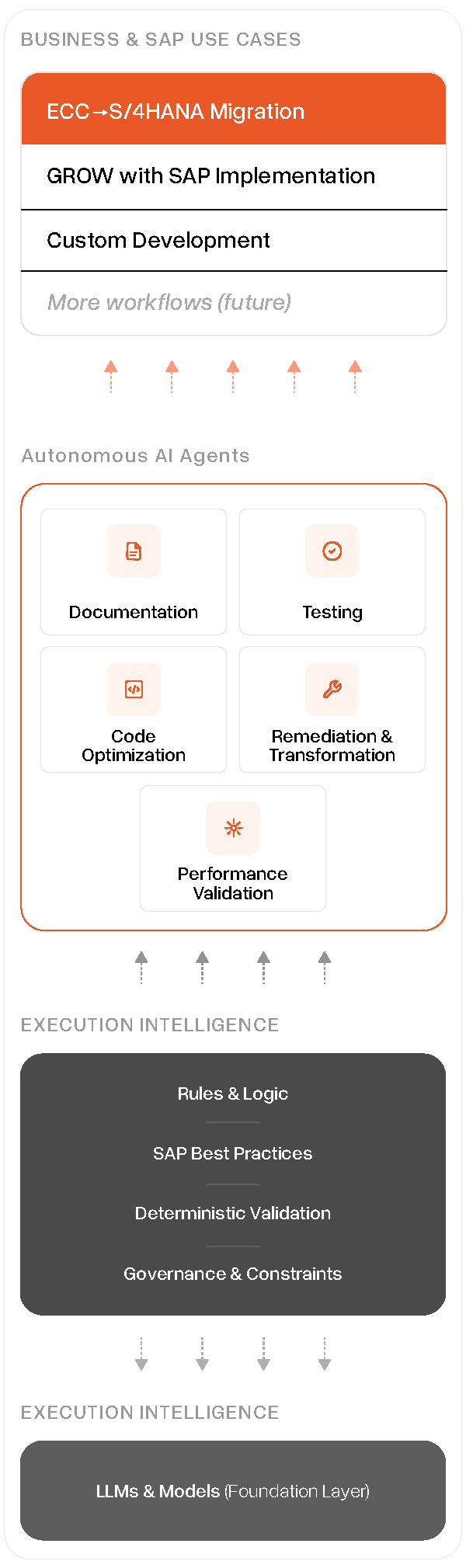
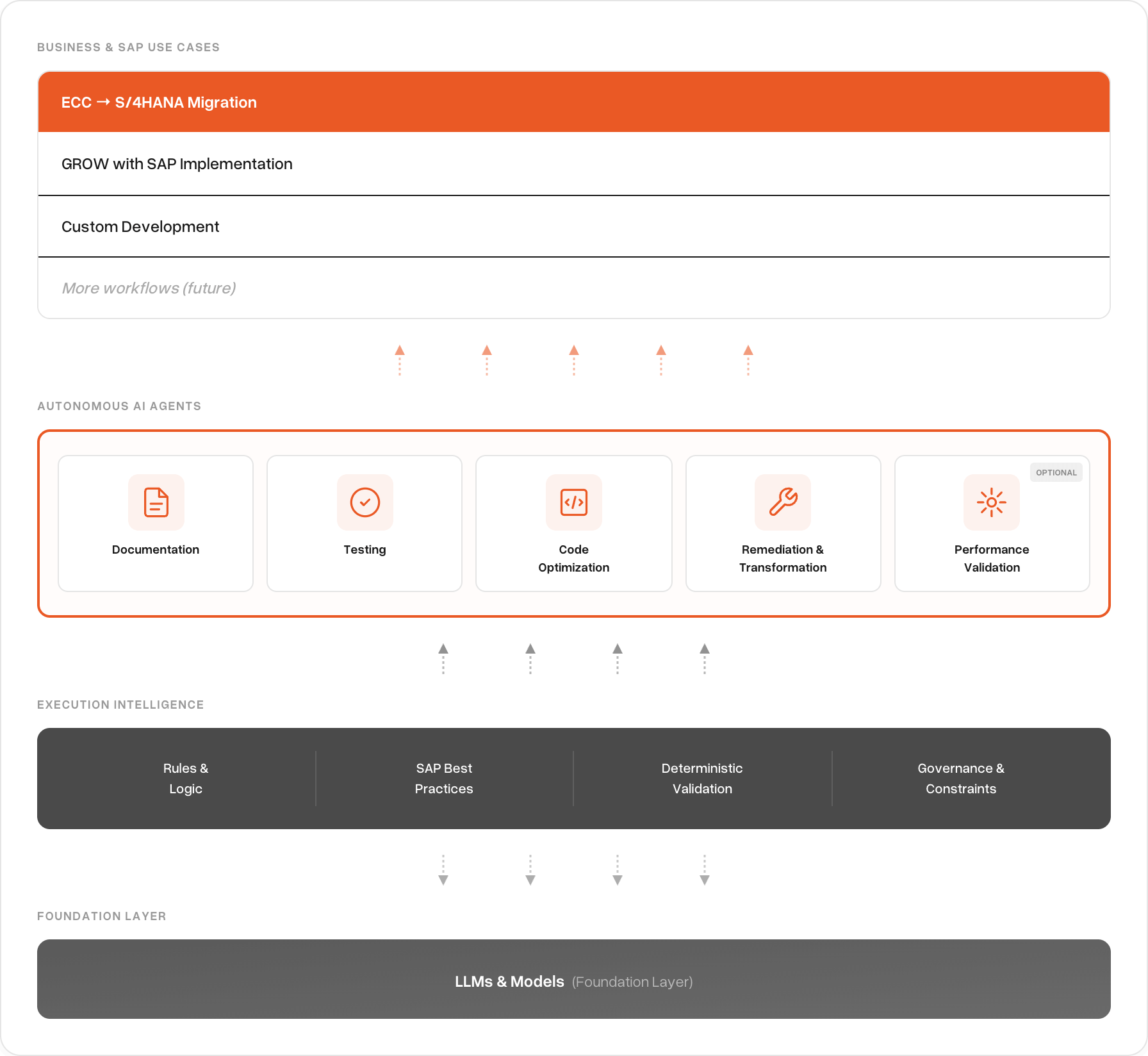
The Sookti AI Architecture Layered Model
At the foundation are state of the art language and reasoning models.
Above that sits a core intelligence layer where domain knowledge lives. This includes transformation rules, analysis pipelines, testing logic, and orchestration primitives that every agent shares.
On top of this are specialized agents, each designed for a specific responsibility, including documentation, testing, code understanding, remediation, and performance analysis.
Finally, product layers orchestrate these agents into complete delivery systems. ECC to S/4HANA migration today, and in the future, greenfield implementations, continuous optimization, and AI driven custom development.
This structure allows individual capabilities to evolve into full delivery platforms.
Where the Expertise Comes From
A common misconception in enterprise AI is that domain knowledge can be learned on the fly. In practice, it rarely can, and almost never at scale.
Sookti sits at the intersection of deep AI systems experience and real SAP delivery expertise.
The team behind Sookti previously built and scaled production AI systems at Doubtnut to over fifty million users. SAP expertise comes through a close partnership with SGN, whose senior architects have spent decades inside real enterprise transformations.
This experience is now being encoded into software. Decades of delivery knowledge, including best practices, heuristics, and failure patterns, are becoming part of the system itself. That is what allows Sookti’s agents to operate with genuine enterprise context.
What Comes Next
ECC to S/4HANA migration is the first visible application.
The same agent platform is being extended toward continuous S/4HANA optimization, greenfield implementations, intelligent custom development, ongoing documentation, and change impact analysis.
This is a shift from projects to platforms.
Our vision is clear: enterprise systems that evolve continuously, safely, and at machine speed, rather than through periodic and painful reinvention.
What Makes This Interesting
Enterprise technology is conservative for good reasons. The cost of failure is high.
But something real has changed.
For the first time, it is possible to encode best in class engineering practices into systems that operate continuously, globally, and in parallel. This does not eliminate the need for human expertise. It changes where that expertise is applied.
Less time executing. More time judging.
Less coordination. More direction.
Less heroics. More reliability.
For the people who work inside these systems every day, this may finally feel like progress.
That, more than any promise of speed or scale, is why Sookti exists.
All the essential intel, from the frontlines of enterprise AI
Analysis, case insights, and learnings on autonomous AI and large-scale systems, delivered as we publish.