Rethinking Brownfield and Greenfield in SAP Migrations
Why AI-driven visibility is reshaping ECC to S/4HANA decisions

For years, one of the biggest questions enterprises have faced during major ERP transitions, like moving from SAP ECC to S/4HANA, has been deceptively simple:
Do we rebuild from scratch, or do we evolve what we already have?
Greenfield or brownfield.
Traditionally, this decision has been framed as a technical one. In reality, it has almost always been a human-constraint problem.
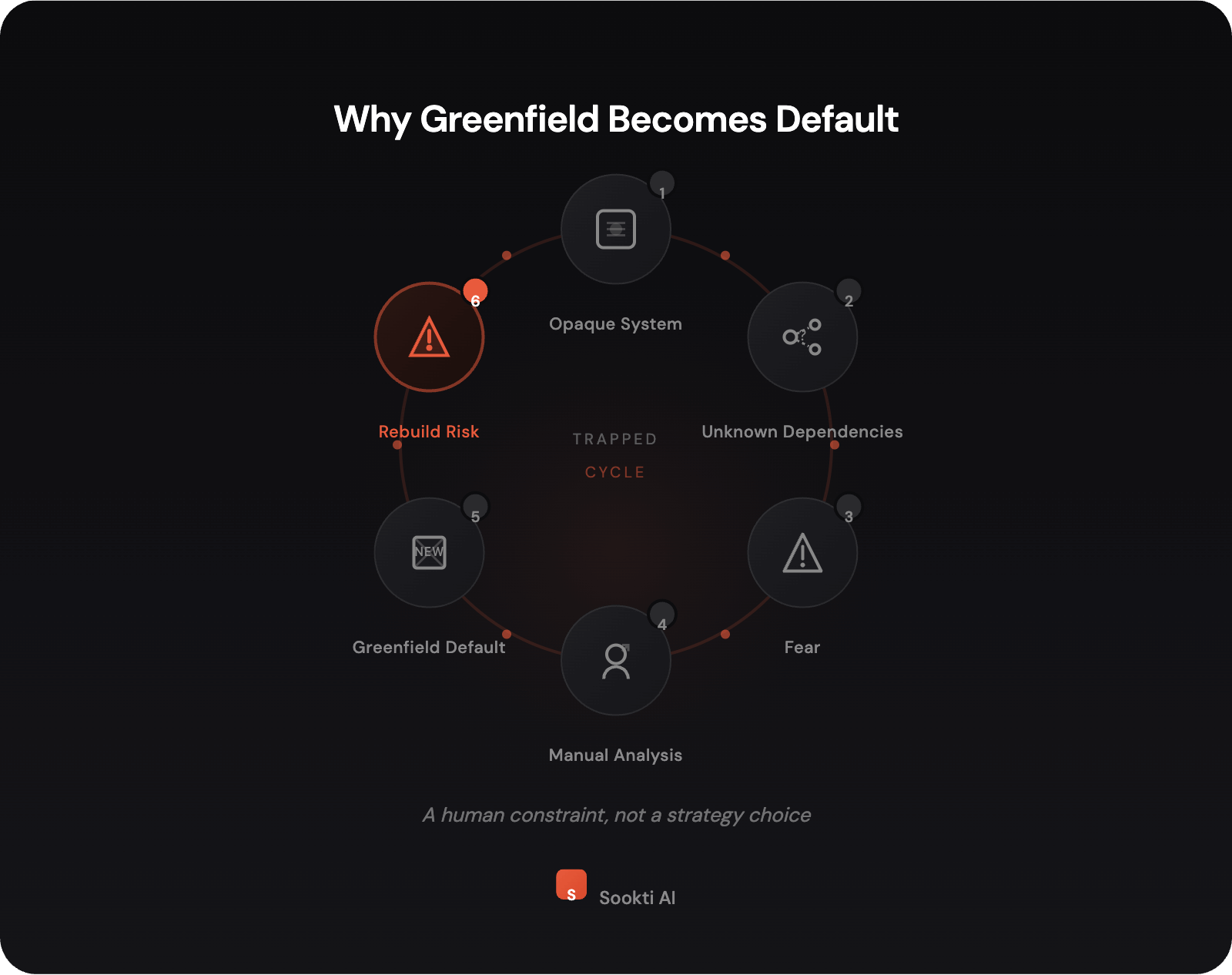
Why So Many Companies Choose Greenfield (Even When They Don’t Want To)
Greenfield implementations were originally meant for moments of genuine reinvention. They made sense when organizations were absorbing multiple acquisitions, collapsing fragmented systems, or deliberately redesigning their operating model end to end.
In those situations, starting fresh can be rational and sometimes even the right choice.
But over the past decade, many enterprises have chosen greenfield for reasons that had little to do with strategy and a great deal to do with anxiety.
ECC systems grew dense over time. Custom code accumulated. Enhancements layered on top of enhancements. Business logic became deeply embedded in programs few wanted to touch unless something broke. The engineers who built the original system moved on. Documentation aged out or disappeared.
Leaders were not just worried about complexity. They were worried about what they could not see.
- “What if something critical surfaced halfway through the migration?”
- “What if a custom program quietly ran payroll or revenue recognition?”
- “What if the people who understood it were no longer around?”
Because answering these questions required humans to manually read code, trace dependencies, interview teams, and reverse-engineer behavior, the fear was not irrational. It was earned.
So greenfield often became the safer-seeming choice, not because it aligned with business goals, but because it reduced the risk of discovering something critical too late.
Why Greenfield Becomes Default
The Hidden Cost of Fear-Driven Greenfield Programs
Greenfield is often described as a reset. In practice, it is a full-scale transformation.
It means rebuilding years, sometimes decades, of embedded business logic. Re-implementing integrations, controls, reports, and workflows. Re-testing entire processes from scratch. Re-training the organization. Re-living stabilization cycles in production.
For some companies, that cost is justified. For many others, it introduces risk, time, and expense that have little to do with value creation and everything to do with our historical inability to truly understand what already existed.
What looked like a technical clean slate often turned out to be an organizational stress test.
What Changes in an AI-Native World
The most important shift AI brings to ERP modernization is not speed.
It is visibility.
For the first time, enterprises are no longer constrained by how many people they can staff to read code, chase dependencies, and reconstruct intent.
AI systems can analyze large ABAP codebases end to end. They can map custom objects, enhancements, interfaces, and data flows. They can identify what is actually used and what is dead weight. They can detect S/4HANA incompatibilities and performance risks. They can infer functional intent from technical implementation, even when the people who built the system are long gone.
This changes the conversation.
The historic driver behind many greenfield decisions, “we do not know what is in there,” no longer has to be true.
From Opaque Systems to Explainable Ones
This shift is no longer theoretical.
At Sookti, it shows up in practice. The agents we build do not just scan code. They understand it. They identify what was built, why it exists, and how it behaves. They flag what must change for S/4HANA compatibility. They surface performance and HANA-specific optimization opportunities. They generate technical and functional documentation automatically.
The result is not automation for its own sake. It is understanding at scale.
And that understanding changes the decision-making frame entirely. Instead of saying, “We should go greenfield because we do not understand our system,” teams can now ask more useful questions:
- Which parts of our system are genuinely differentiated?
- Which parts should be modernized or simplified?
- Which parts can be retired altogether?
- Where does greenfield make sense for business reasons, not fear?
The Problem Wasn’t Brownfield or Greenfield
Traditional Decision Frame
- Fear drives strategy
- Binary choice
- Partial code visibility
- High uncertainty
- Human-led discovery
AI-Native Decision Frame
- Selective carry-forward
- Targeted redesign
- Full system visibility
- Lower uncertainty
- Agent-led analysis
The shift from human-limited discovery to AI-native visibility reshapes how modernization decisions are made.
Brownfield Doesn’t Have to Mean Carrying Everything Forward
Another outdated assumption is that brownfield means lift-and-shift and that it requires inheriting every compromise, shortcut, and piece of technical debt accumulated over the years.
In an AI-assisted world, brownfield can be selective.
Stable, valuable customizations can be preserved. Risky or inefficient code can be refactored. Unused programs can be retired. Redesign can be targeted only where the business genuinely needs change.
When AI agents handle large-scale analysis, remediation, HANA-tization, testing, and documentation, brownfield stops being about blind inheritance. It becomes a series of informed, surgical decisions made with full visibility.
The Real Reason Why Most Brownfield Migrations Fail
Brownfield migrations do not fail because enterprises choose the wrong path. They fail because legacy custom code is carried forward without being rethought for SAP HANA.
Code written for ECC often assumes database behaviors that no longer hold true in S/4HANA. Heavy customizations, inefficient queries, and tightly coupled logic may technically migrate, but they do not perform. Reporting slows down. Runtime spikes. Systems that once worked reliably become fragile in production.
This is where most brownfield programs stumble, not at migration, but at optimization.
AI-driven code analysis and remediation change that outcome. By understanding what custom code actually does and how it behaves on HANA, enterprises can selectively refactor what matters, retire what does not, and modernize without disruption.
This difference becomes clear in practice.
See how we avoided common brownfield migration pitfalls for a global textile manufacturer by optimizing SAP custom code and improving reporting runtimes by over 80%.
When Greenfield Still Makes Sense
None of this eliminates the need for greenfield.
There are still moments when starting over is the right choice. This includes when the business itself is being redesigned, when multiple ECC systems must be collapsed into a single global core, when core processes are intentionally being re-architected, or when an enterprise wants to decisively break from its historical operating model.
The difference is that the decision can now be driven by strategy rather than anxiety.
A Different Way to Think About ECC to S/4HANA
The ECC to S/4HANA journey is not just about moving systems. It is about ensuring that what moves forward actually works on HANA.
When legacy systems become explainable, migration stops being a leap of faith. Decisions about brownfield and greenfield become grounded in evidence rather than fear.
The most important question is no longer brownfield or greenfield.
It is this:
What custom code can be safely carried forward, and what must be optimized or re-imagined so the system actually performs on S/4HANA?
That question tends to linger. And it should.
All the essential intel, from the frontlines of enterprise AI
Analysis, case insights, and learnings on autonomous AI and large-scale systems, delivered as we publish.