How Agentic AI Compresses SAP Migrations from 18 Months to 6
Most enterprises will miss the 2027 deadline. Autonomous execution changes the math.

On December 31, 2027, SAP withdraws mainstream maintenance for ECC. For the thousands of enterprises whose financials, procurement, logistics, and compliance live on that platform, this is not a software upgrade notice. It is an architectural reckoning with a fixed horizon.
The successor, S/4HANA, runs on a different foundation entirely: an in-memory columnar database, a simplified data model, real-time analytics, and a cloud-native innovation layer. Staying on ECC past the deadline means paying premium extended maintenance fees for an asset that is actively depreciating, all the while being locked out of the product roadmap SAP is actively building toward.
Yet most enterprises have not moved. The reasons are understandable: opaque subscription economics, the genuine risk of disrupting mission-critical systems, and institutional fatigue from prior failed IT programs. Many CIOs find themselves suspended between the urgency of the deadline and the paralysis of risk.
Beneath all of this lies a constraint that is structural rather than strategic.
The pool of top-tier SAP migration experts is shrinking relative to demand. Enterprises that delay longest will face the worst of it: inflated costs, extended timelines, and a dangerous dependence on consulting teams already stretched thin.
The clock is not just ticking on maintenance. It is ticking on execution capacity.
Why SAP Migrations Take 18 Months
1. A New Foundation, Not a Patch
S/4HANA is not ECC with a new interface. It is an architectural shift, from row-based relational systems to HANA’s in-memory, columnar engine, built on a simplified data model.
Consider what this means concretely.
The unified journal table ACDOCA consolidates what were previously separate financial ledger, controlling, asset accounting, and material ledger tables (COEP, FAGLFLEXA, ANEP, MLIT, and others) into a single line-item structure.
MATDOC replaces the legacy MSEG and MKPF material document tables.
PRCD_ELEMENTS replaces the pricing condition table KONV.
These are not rename operations. They are structural redesigns: different field mappings, different data types, different access patterns. For a consultant, each redesign means manually re-mapping thousands of field dependencies while keeping the System of Record intact. This only makes the risk of regression inherent to the process.
2. The Weight of Legacy Code
A typical large enterprise carries thousands of custom ABAP programs, reports, enhancements, and interfaces layered on top of standard SAP over decades. Much of this code is undocumented, written by consultants who left years ago, with dependencies spanning multiple modules. This is not abstract technical debt. It is the working logic of month-end closes, tax calculations, procurement workflows, and regulatory compliance.
SAP's Clean Core mandate compounds the challenge: keep the S/4HANA core standardized, push customizations into external extensions via BTP.
For enterprises carrying 15 to 25 years of accumulated custom objects, that mandate is easily stated and enormously difficult to execute.
3. The Knowledge Problem Nobody Talks About
SAP maintains hundreds of thousands of database tables and millions of unstructured notes documenting what changed between ECC and S/4HANA. A single table may have thousands of related notes across releases, each version-specific and requiring expert interpretation to apply correctly.
No centralized repository maps these changes comprehensively. Developers must manually cross-reference notes to understand deprecations, compatibility rules, and migration strategies for every table, every object, every field.
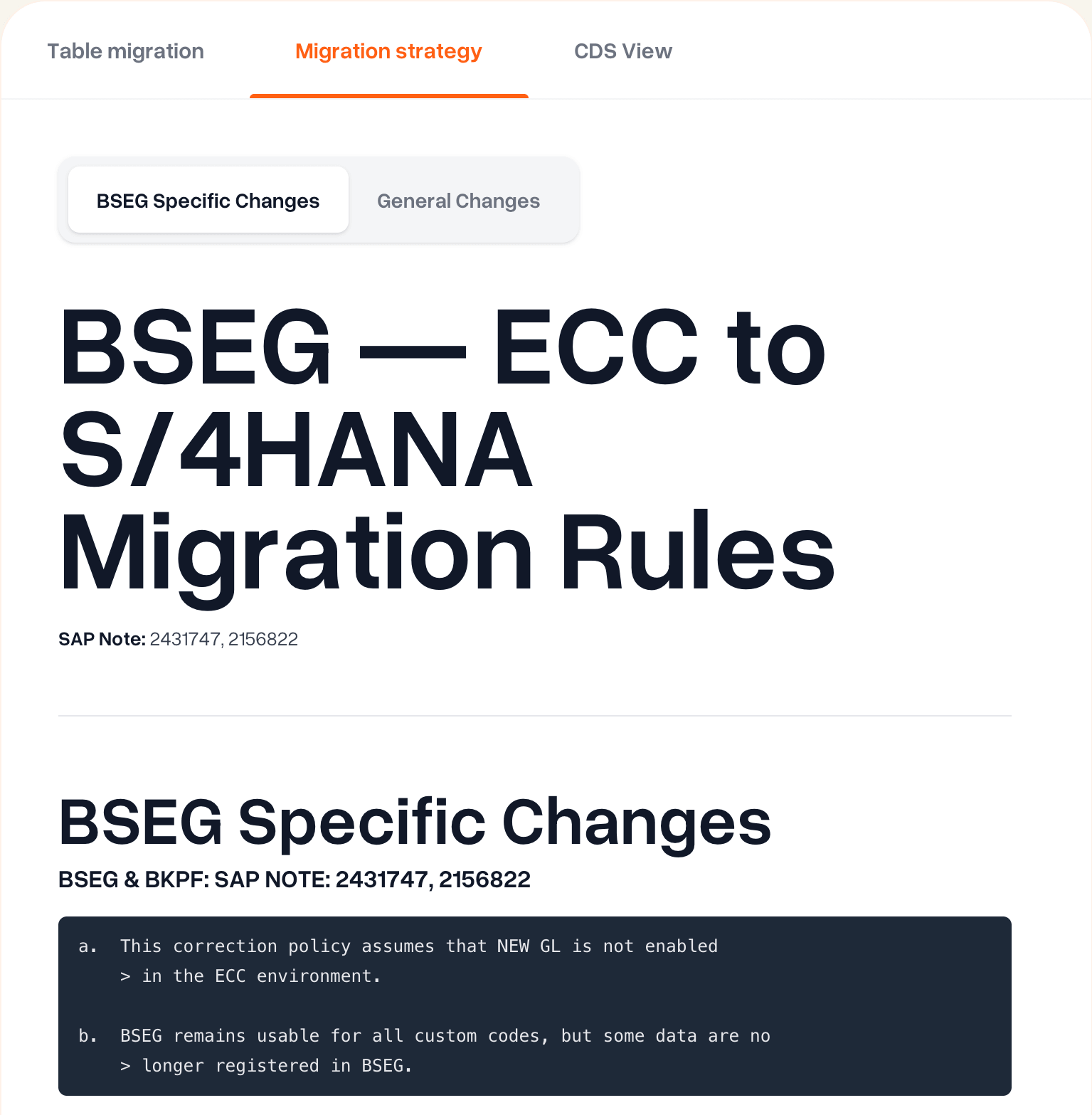
SAP's migration logic, fragmented across millions of notes. Every object traditionally requires manual interpretation.
That research burden, restarted from scratch on every engagement, is what makes eighteen-month timelines feel not only common but inevitable.
What the Best ABAP Developers Actually Do (And What They Cannot)
Before understanding how agents help, it is useful to examine what the best human developers actually do.
A senior ABAP developer working on HANAtization must understand the original business logic, identify deprecated tables and fields, determine the correct CDS view replacements, optimize SQL access patterns for HANA’s columnar architecture, validate functional equivalence, and document every decision.
The best developers execute this with precision. Most consulting firms rely on a small cadre of such practitioners, individuals who have internalized data model changes, know which SAP Notes matter, and recognize when HANA-specific access patterns are required. Their expertise is exceptional.
But it is also largely implicit, built over years of experience and difficult to scale.
They are ultimately constrained by cognitive limits and throughput. One mind, one object at a time.
Why the Consulting Model Cannot Scale
Traditional SAP migration programs rebuild their execution model from scratch for every engagement: research, mappings, playbooks, and institutional knowledge. Even with standardized methodologies, the underlying execution machinery resets each time. The same research is repeated. The same decisions are rediscovered.
Under time pressure, optimization is deprioritized. Migrations default to lift-and-shift approaches, and performance issues surface only after go-live.
How Agents Replicate the Reasoning of a Top 1% Developer
Sookti’s agents are designed to mirror the workflow of top-tier ABAP developers.
Each stage of the workflow is handled by a dedicated agent, allowing the entire sequence to scale horizontally across thousands of custom objects in parallel. The work is the same as a human developer's: agents read the custom code, identify deprecated tables and fields, determine the correct S/4HANA equivalents, apply HANA-native optimization patterns, validate functional equivalence, and generate documentation that records every decision alongside the governing rule.
The difference is that it is executed concurrently and with consistency across the entire landscape. This fundamentally changes how SAP execution scales.
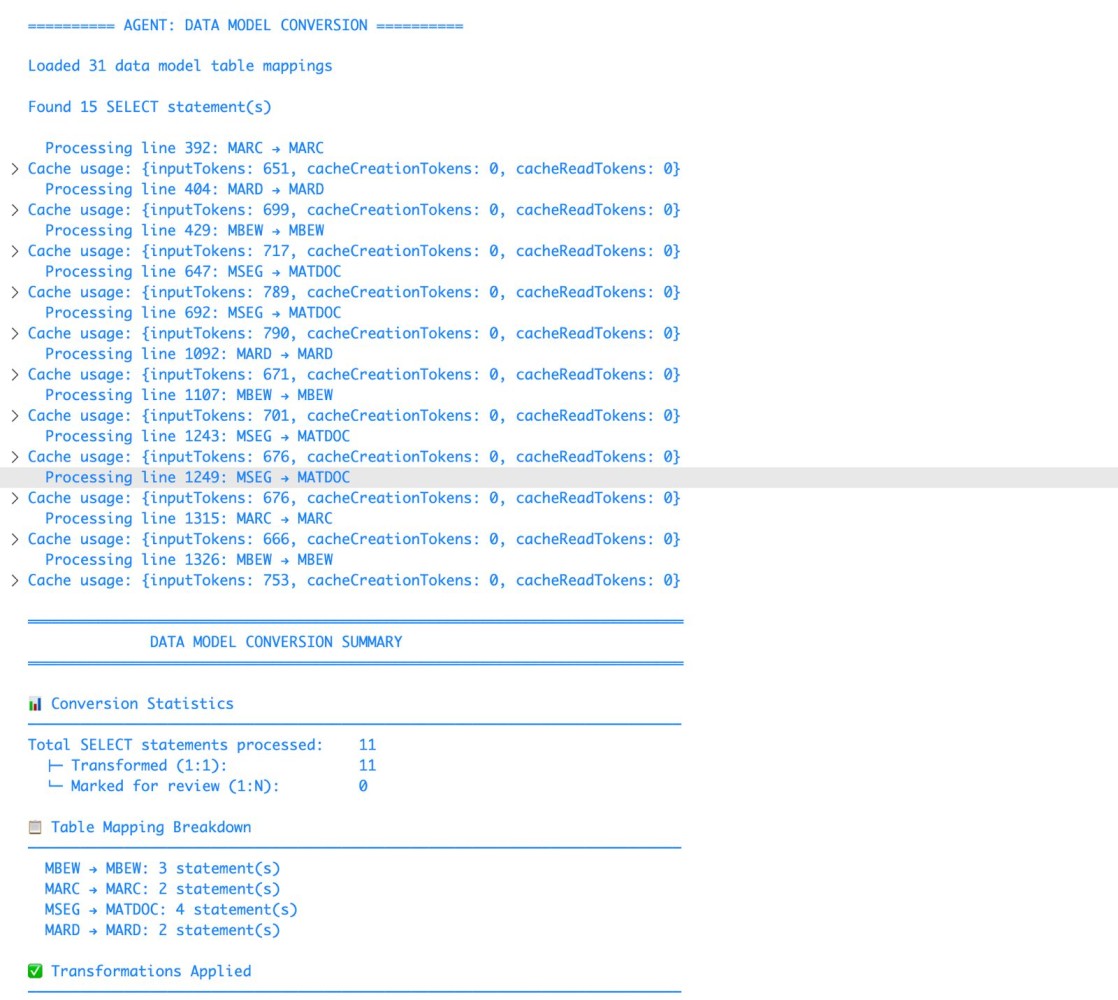
Agents process and apply data model mappings across the entire codebase, object by object, in parallel.
Traditional delivery grows linearly, more objects require more consultants, along with the overhead of coordination and variability in quality.
Agentic execution shifts this to compute.
As workload increases, agents scale in parallel, eliminating coordination bottlenecks while maintaining consistency and precision.
How the Timeline Compresses: 18 Months to 6 Months
Same migration workflow, faster execution
The parallelization gain is largest in the assessment and remediation phases, where human throughput is most constrained.
Sookti's Four-Step Autonomous Execution Workflow
At the core of Sookti's agentic system is an orchestration layer that parses the client’s SAP landscape and distributes work across agents at scale. For each custom object, four agents operate in sequence, performing Code Analysis, HANAtization, Validation, and Documentation.
This sequence is not limited by volume. Whether the landscape contains 500 objects or 20,000, the same four-step workflow executes concurrently across all of them, maintaining consistency and quality without degradation.
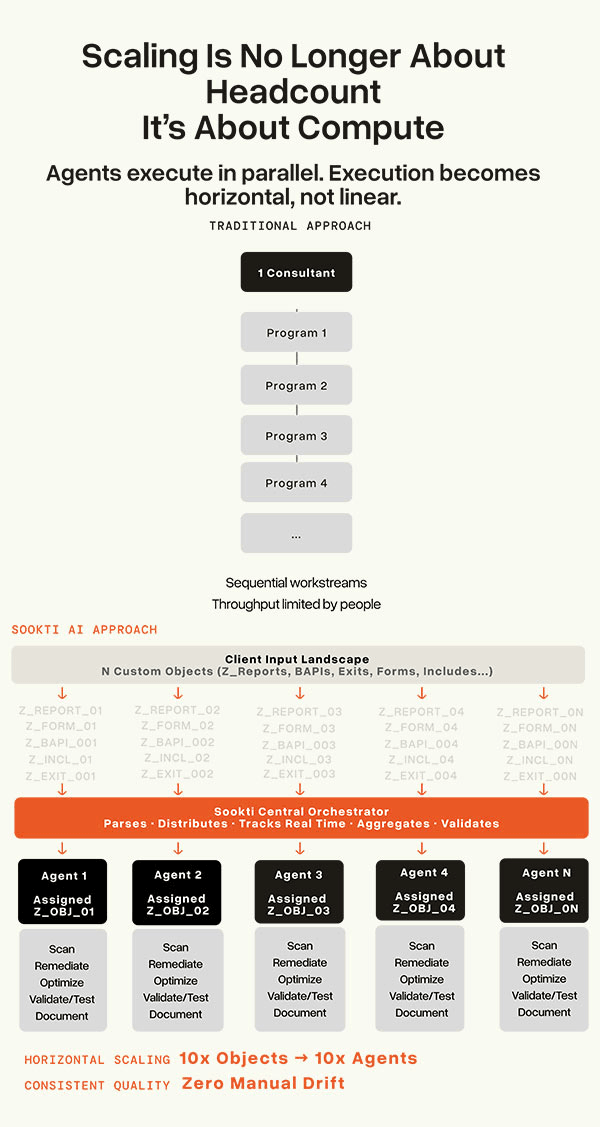
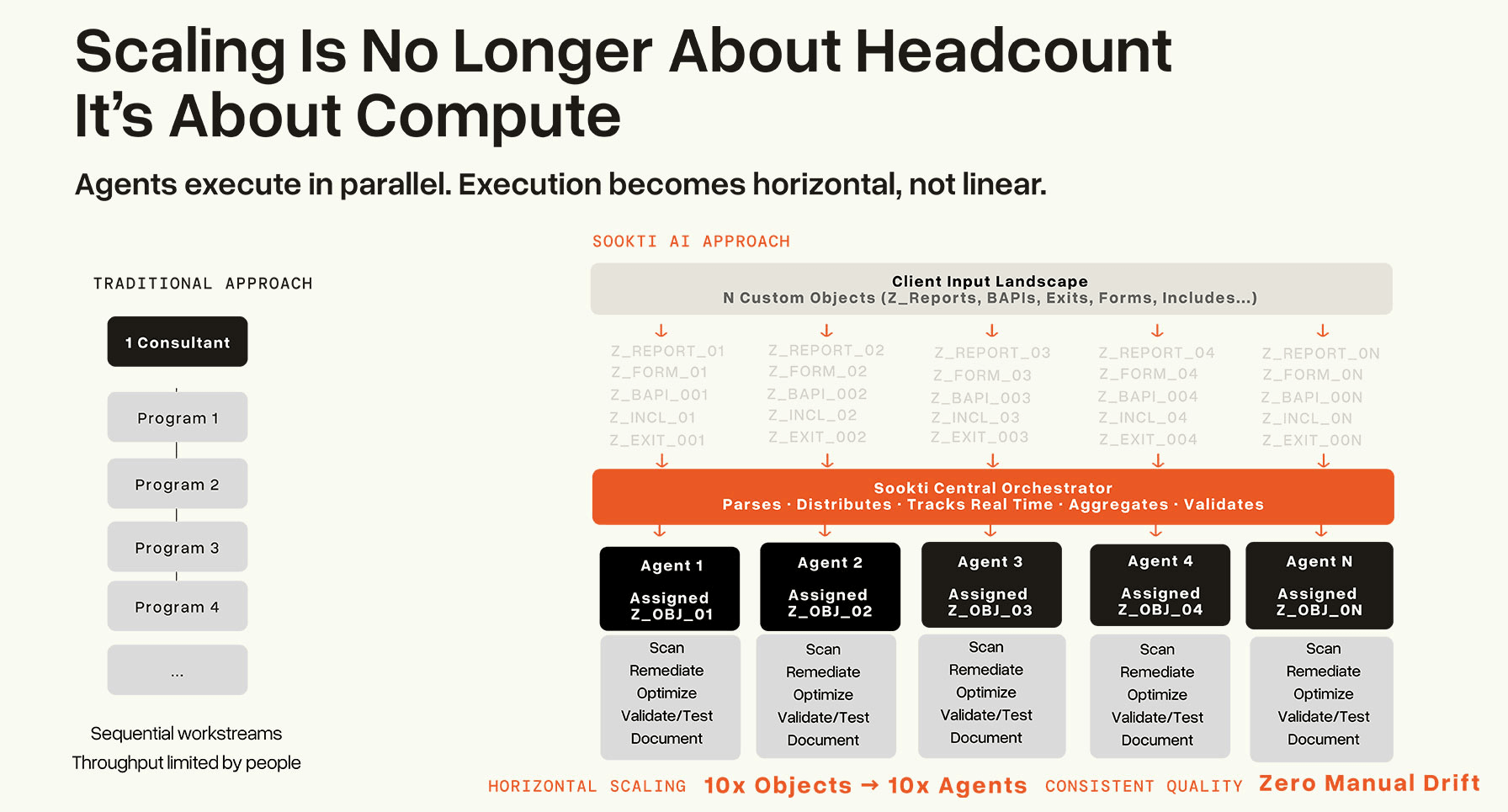
The difference between traditional consulting model and Sookti AI's agentic model
Step 1: Full Custom Code Analysis
The Code Analysis Agent parses millions of lines of custom code in hours, rather than weeks, creating a complete, queryable inventory of the entire custom object landscape. This initial scan identifies deprecated tables, field-level changes, performance anti-patterns, and cross-module dependencies before any code is modified. The result is a living, structured layer of migration metadata that serves as the foundation for all subsequent transformations.
Step 2: Transformation
The transformation agent draws on three distinct sources of intelligence to rewrite code for S/4HANA.
These sources form the architectural backbone of the Sookti's agentic AI system. Each addresses a different dimension of the migration problem, and together they remove the uncertainty that makes unstructured AI unreliable in enterprise environments.
a. Rule Enforcement Layer
The first source is a rule engine: a codified definition of what high-quality, HANA-optimized ABAP should look like. These are the principles that experienced SAP performance engineers apply instinctively, but which are often compromised under delivery pressure. Sookti encodes them as programmatic guardrails.
- Database access optimization. SELECT statements are never executed inside loops. Loop-based SELECT SINGLE calls are replaced with bulk retrieval using FOR ALL ENTRIES, followed by sorted in-memory lookups with BINARY SEARCH. SELECT * is eliminated in favor of column-specific queries, aligning with HANA’s columnar architecture.
- Internal table handling. Sorted tables with binary search are used for key-based access. Nested loops are replaced with parallel cursor techniques, reducing complexity from O(n²) to O(n+m). DELETE ADJACENT DUPLICATES is applied post-sort, and ASSIGNING FIELD-SYMBOL replaces INTO to avoid unnecessary data copying.
- Memory management. Temporary internal tables are explicitly released using FREE once processing completes. Large working tables are not carried across loop iterations, preventing memory spikes and short dumps under production-scale volumes.
- Code pushdown. Computation, aggregation, and filtering are pushed to the database layer via CDS views and Open SQL expressions, leveraging HANA’s in-memory processing. This follows SAP’s architectural direction of minimizing data movement between application and database layers.
- Clean Core compliance. Every transformation is validated against Clean Core principles. Standard SAP logic is preserved, while true customizations are flagged for BTP extensions. Deprecated table access is replaced with standard CDS views.
Because these rules are enforced programmatically on every object, compliance does not degrade under time pressure or scale.
b. Knowledge Base
The second source is Sookti’s proprietary Knowledge Base: a machine-readable map of ECC-to-S/4HANA transition logic. While SAP has published millions of Notes documenting system changes, they remain fragmented. Sookti distills this corpus into deterministic mappings across three core categories:
- Table replacement mappings. A structured map of deprecated, replaced, or restructured ECC tables, with field-level transformations. For instance, MSEG/MKPF to MATDOC, COEP/FAGLFLEXA to ACDOCA, and KONV to PRCD_ELEMENTS. Each mapping captures not just table substitutions, but structural differences, data type changes, and object-specific migration strategies.
- CDS view structures and selection logic. A graph of standard SAP CDS views, including their associations, joins, and underlying abstractions. For each data access pattern, the system evaluates and ranks candidate views, selecting the most appropriate standard option. Custom CDS views are generated only when no standard alternative exists.
- Field-level compatibility changes. A record of data type modifications across S/4HANA versions, such as field length reductions or complete type changes, ensuring accurate transformation at a granular level.
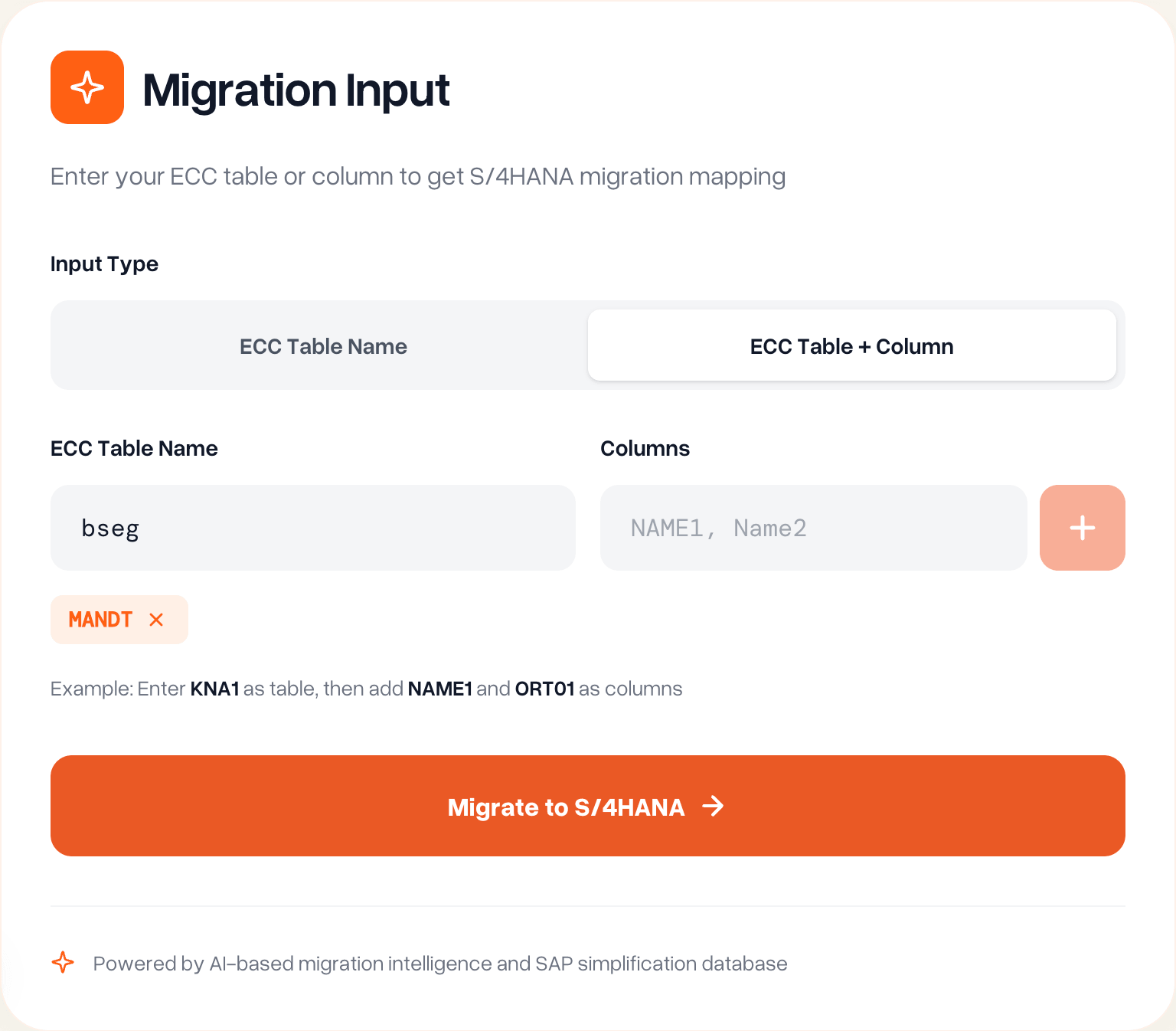
Sookti's proprietary Knowledge Base
This intelligence is company-agnostic and compounds over time. Work that consulting teams typically reconstruct for each project becomes persistent infrastructure. Agents also continuously ingest new SAP Notes, normalize changes, and update mappings across versions. This makes tribal knowledge systematized and reusable.
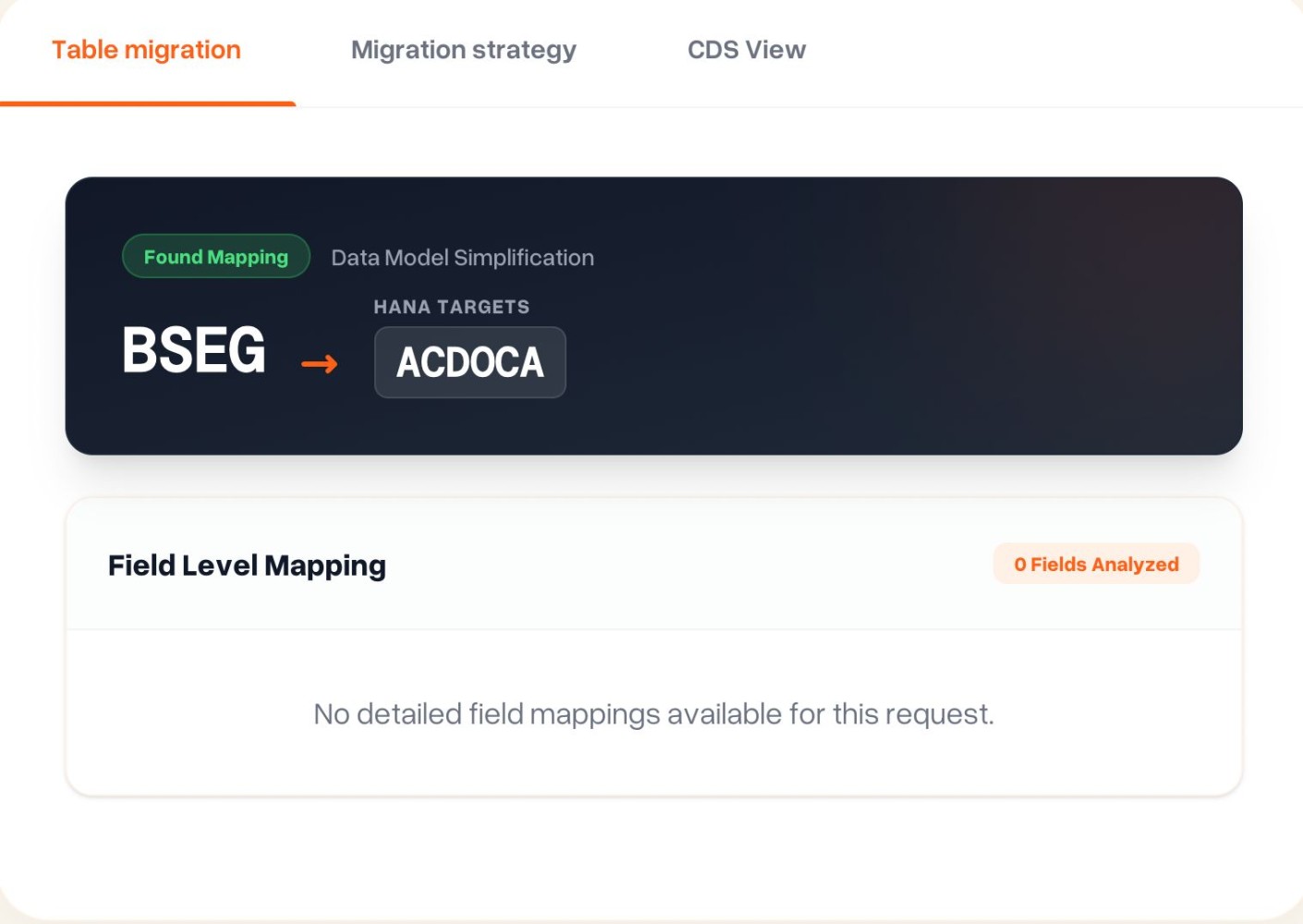
Structured mappings replace manual research. Table transformations are applied deterministically, not rediscovered per project.
c. Context Engineering
The third source is the client’s own codebase, already parsed and understood by the agents. The target SAP version, active modules, data mappings, and full custom object inventory are combined with the Knowledge Base to construct system-specific context.
This context determines the exact transformation required for each object: which table replacements to apply, which CDS views to select, which field-level adjustments are necessary, and which segments must be preserved as genuine business logic.
What once required weeks of consultant-led reverse engineering is embedded directly into the execution framework, enabling precise, context-aware transformation at scale.
Step 3: Autonomous Validation
Once transformed, each object is subjected to three layers of validation.
- Functional equivalence testing compares outputs between the original and transformed code to ensure business logic is preserved.
- Structural validation verifies that deprecated objects have been replaced, mappings correctly applied, and S/4HANA compatibility achieved.
- Performance validation measures runtime, query efficiency, and memory impact using quantitative benchmarks rather than subjective assessment.
In low-volume sandbox environments, performance gains may appear marginal. The impact becomes clear at production scale, where reduced database round-trips and improved memory efficiency translate into materially faster execution.
Step 4: Documentation
Every transformation is documented automatically. The Documentation Agent inserts inline comments that explain each change and the rule governing it, creating a transparent audit trail at the code level.
In parallel, functional and technical specifications are generated in audit-ready formats, ensuring complete traceability across the transformation process. This eliminates any knowledge loss that typically accompanies large-scale SAP programs.
For a closer look, explore the demo.
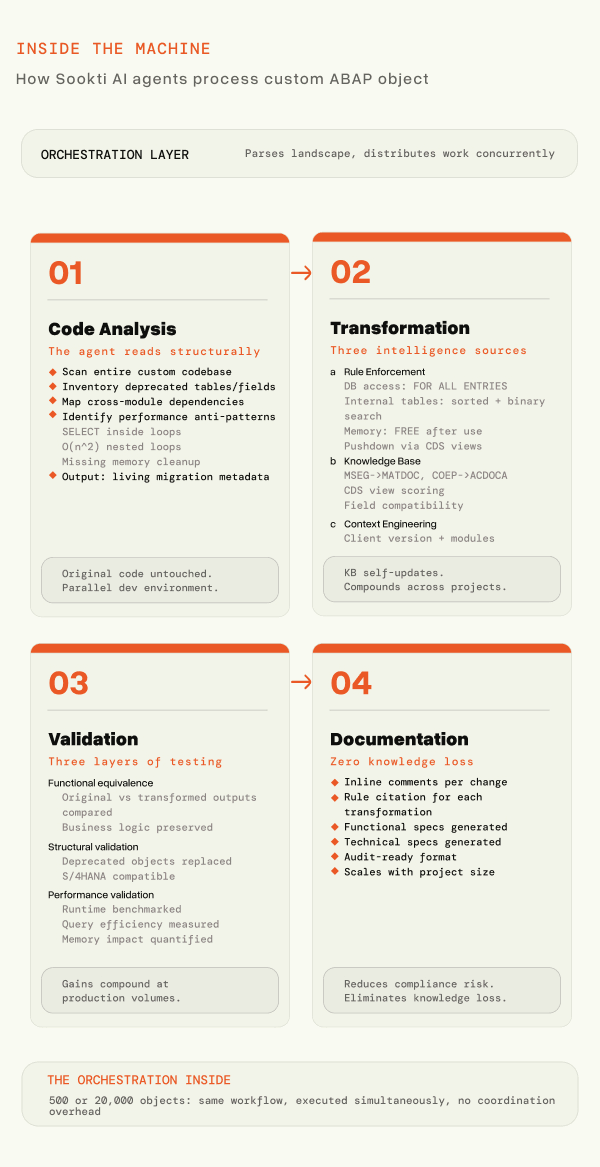
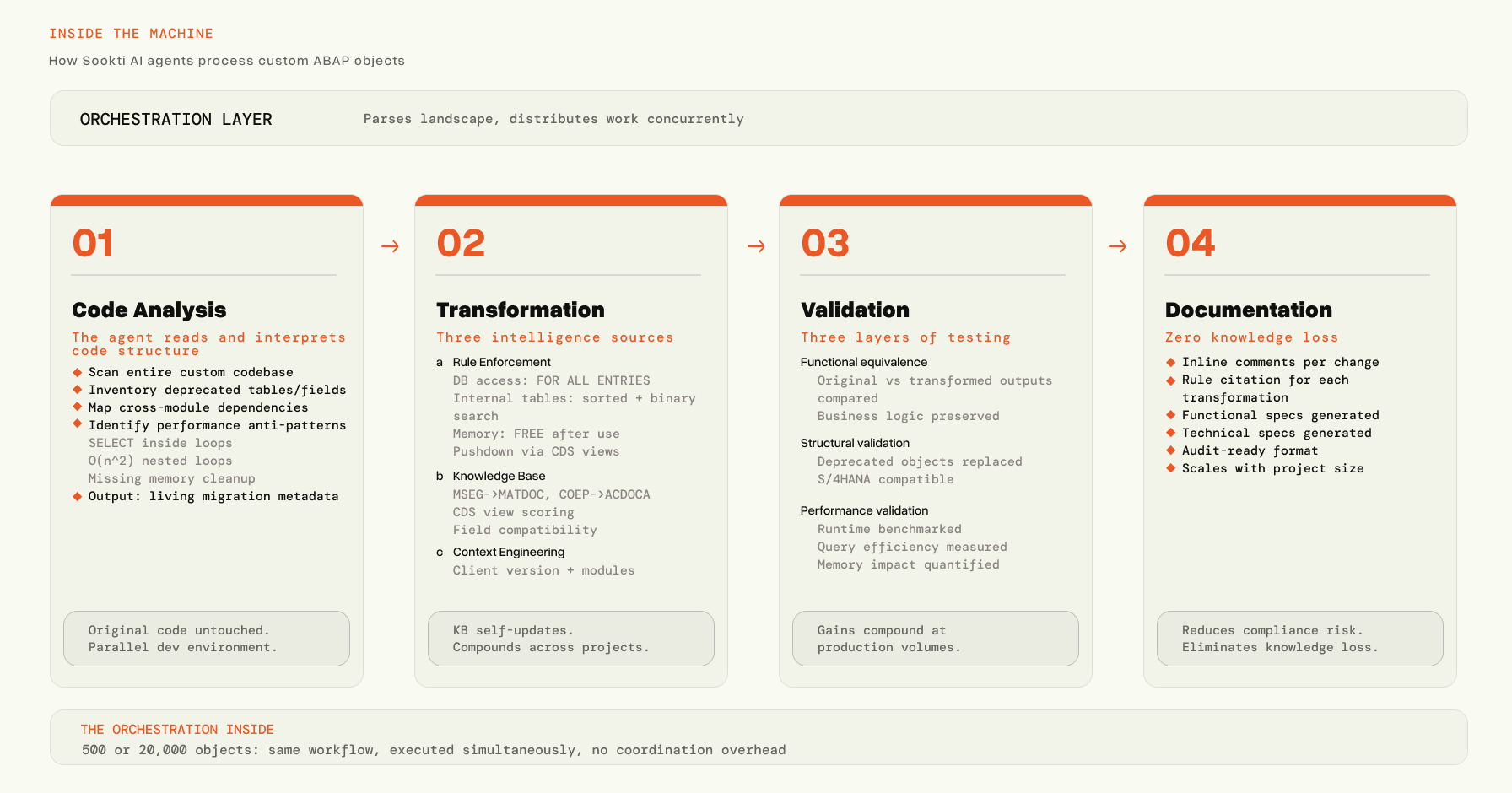
How Sookti AI agents actually work
Enterprise Governance and Risk Control
Every transformation runs in a version-controlled, isolated environment. Original ECC programs remain untouched throughout.
Human SAP experts remain in the loop, reviewing and approving each batch as it progresses from development to QA to production, maintaining full governance without becoming the throughput constraint.
Every decision is auditable and every transformation is traceable, ensuring control at scale without compromising speed.
What This Looks Like in Practice
For one of India's largest cement manufacturers, Sookti's agents refactored 110,000+ lines of custom ABAP, reduced critical report runtimes by up to 80%, and delivered the entire optimization in one day versus the months it would have taken traditionally, with estimated cost savings of 80 to 90% over conventional remediation.
We’re walking through this live on May 20 and 21. If you're evaluating S/4HANA migration, you can book a spot.
From Consulting Engagements to Execution Infrastructure
Sookti replaces the traditional consulting model with a persistent execution layer that carries forward across engagements.
The Knowledge Base, rule enforcement models, table mappings, CDS optimization logic, and validation patterns accumulate and improve over time. While each client landscape is unique, the execution does not restart.
Scaling becomes a function of compute, not headcount.
This approach extends beyond ECC-to-S/4HANA migration to SAP BTP implementations, PI/PO to Integration Suite transitions, and broader RISE and GROW programs, anywhere SAP workloads require structured transformation, validation, and documentation.
The shift is not from services to product.
It is from manually coordinated execution, dependent on individual expertise, to infrastructure-driven orchestration, where that expertise is systematized, compounded, and applied consistently at scale.
To explore what this means for your landscape: ruchi@sookti.ai | tanushree@sookti.ai
All the essential intel, from the frontlines of enterprise AI
Analysis, case insights, and learnings on autonomous AI and large-scale systems, delivered as we publish.